Meet Our Chief Science Officer, Dr. Karen Fortuna
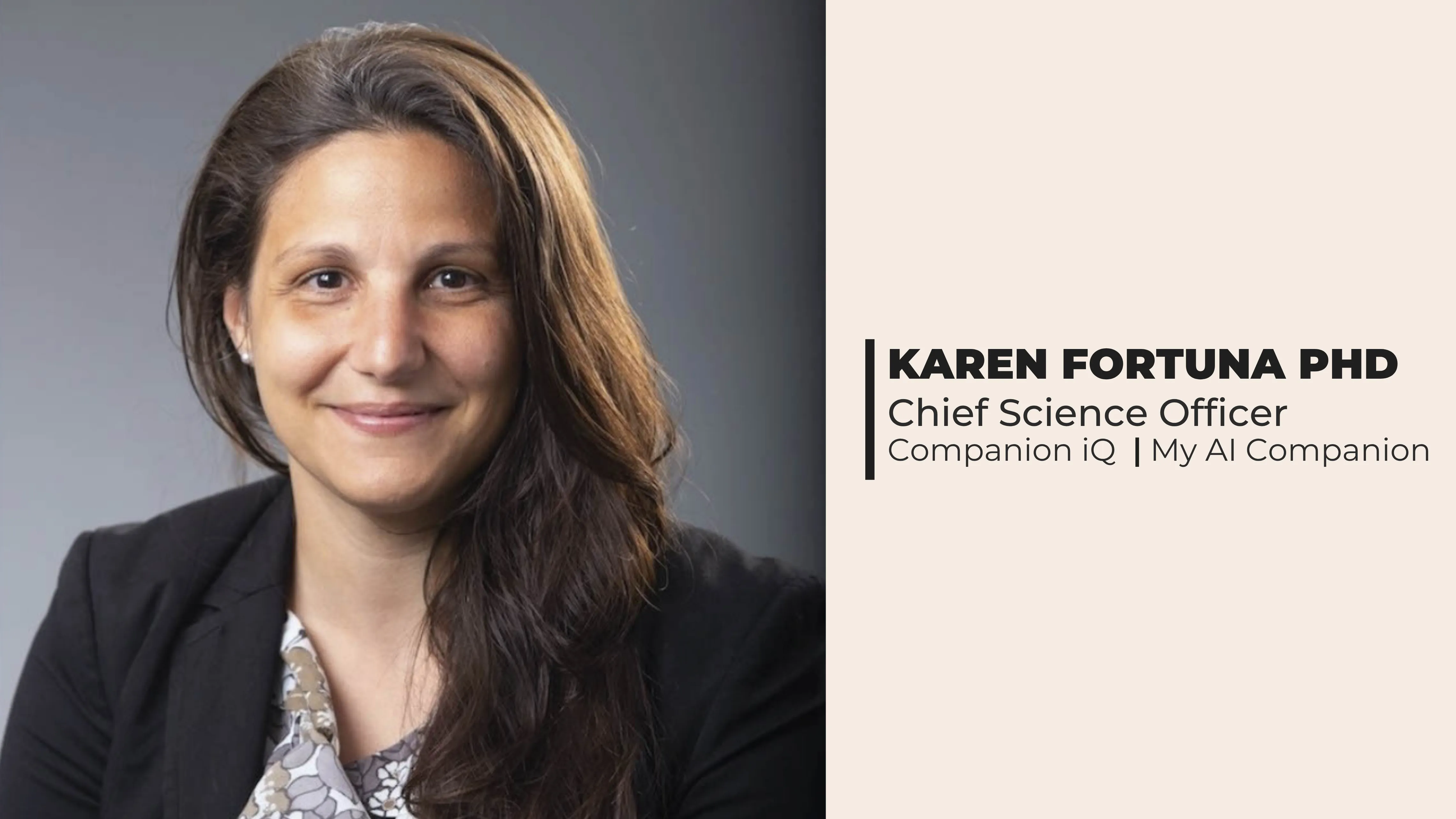
Karen Fortuna, Chief Science Officer of My AI Companion, is a licensed clinical social worker with a PhD in Social Welfare, and an assistant professor of psychiatry at Dartmouth’s Geisel School of Medicine who was awarded an NIMH K01 award (K01MH117496), a NARSAD Young Investigator Grants from the Brain and Behavior Foundation, and The Alvin R. Tarlov & John E. Ware Jr. Award in Patient Reported Outcomes for her work. With more than 130 peer-reviewed publications co-authored with patient partners in journals such as the Journal of the American Medical Association-Open Network and the Lancet, her work has also been featured in national media outlets such as Forbes, Newsweek, and Fox Business. Dr. Fortuna is a former Health and Aging Policy Fellow and an American Political Science Congressional Fellow.
As a fellow, Dr. Fortuna’s efforts have focused on shaping primary care and technology policies that address the needs of populations who face early mortality and may not have the chance to live into older adulthood. Her mission is to empower our healthcare system so that all people, despite social determinants of health (SDOH) that might negatively influence their future quality of life (such as economic instability, lack of access to education, lack of neighborhood infrastructure and/or community, etc.) have access to resources that will help them live longer, healthier lives.
What drew you to working with a population facing poor SDOH?
I chose social work because growing up my dad, Dave, had a rare progressive form of multiple sclerosis and was very sick. He was in a wheelchair with limited mobility, eyesight, and capacity to move his arms, on top of cognitive impairments from the disease. He was marginalized by some, because he was in a wheelchair, but to me he was always just my dad. Not different. Not helpless. Actually he was one of the most capable people I’ve ever known, who, after getting diagnosed, and with a successful business, went back to school to become the first member of our family to get a college degree. He was amazing.
He used to say, “Kar, I’ll probably never use this degree, but I got it for you. It was because I wanted to show you that anyone can do anything, despite their challenges.”
Despite my dad’s prognosis, he thrived. My dad had access to medical treatment and support services. I saw the impact of pharmacological treatment, telephonic peer support, transportation assistance to get to the gym, and an electronic wheelchair, which helped him to live a full and meaningful life. I also saw the impact of his hug calendar. If you knew Dave, you know he tracked every hug he received and, at one point, he was up to 900 days of straight hugs!
The power of his support systems (phone calls every night and rides to get those hugs!), bolstered by technology (he passed on in 2006, we’ve come a long way in terms of technology), changed his life and changed mine. I hope to honor his legacy by working with peer support specialists and through digital peer support to increase access to people in need, like my dad, so they, too, can live full and meaningful lives.
Tell us more about digital peer support and how you got involved in this area of research?
Digital peer support is live or automated peer support services delivered through technology mediums. A peer support service is support given by an individual trained in support, but facing similar medical and/or mental health conditions.
My first exposure to mental health services began in the first year of my Masters in Social Work internship at the University of Pennsylvania. I provided group-based self-management training to adults living with both mental and chronic health conditions. I was impressed by the severity of disabilities that were present for these adults, despite participation in evidence based programs.
It was through a volunteer opportunity with Dr. Mark Salzer that I developed an understanding of the peer recovery movement, peer perspectives, and theories of service delivery. When I saw recovery first hand, I was sold! This laid the foundation for my research career focused on digital peer support as an innovative service delivery strategy.
My work with peer support specialists uses a co-design approach to our research. Co-design involves shared decision making in all aspects of the research process, supporting collaboration, engagement, co-learning, partnership, trust, transparency, and honesty.
Peer support specialists bring insight and energy to our research and we believe that will lead to better outcomes. Because if the people most affected by a condition are not shaping the research questions, the outcomes, and the implementation strategy, we shouldn’t be surprised when findings don’t translate.
For more of my research on Moving Beyond User-Centered Design to Improve Population Health: https://www.youtube.com/watch?v=DoOVUmsLlbk
Do you ever feel like enough-is-enough with technology?
In some ways I’m a total luddite. For example, I always prefer a good old-fashioned telephone call to a Zoom meeting. Technology is great, but it’s also nice to go offline and disengage. Part of why we designed My AI Companion the way we did was because we didn’t want to add more technological load to our already over-stimulated brains. A simple phone call, even on a landline. An easy text to respond to at your leisure. The goal is to get users engaging with their lives using tools they want to use, not addicted to one more machine.
Do you really think healthcare can change?
My dad showed me “that anyone can do anything, despite their challenges.”
I believe the same is true of the healthcare system. Despite the massive challenges, we can improve the system to ensure that all people have the same opportunities to live a long healthy life by building products that support mental health, especially as it correlates to medical health. To do so, we need patient voices included in all aspects of our research. Patients who need to be valued, respected, and listened to, because they are showing us the best, most effective ways to improve their lives.
My dad died really young and did not have the chance to reach older adulthood, but his legacy of hope, resilience, and empowerment is embedded in the work that we do and it’s why I partner with the most vulnerable. I want a world where EVERYONE is able to live a long, meaningful life.